


"Our ultimate aim is that of Voltaire and of the French Revolution - the final destruction of Catholicism, and even of the Christian idea."
The Permanent Instruction
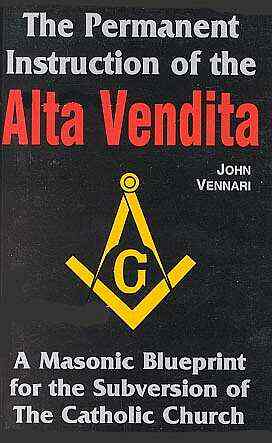

Freemasonry is an association . . . an institution . . . so it is said . . . but it is not that at all. Let us lift up all the veils, risking even to evoke numberless protestations. FREEMASONRY IS A CHURCH: It is the Counter-Church, Counter-Catholicism: It is the other church -- the church of HERESY, of Freethought.
Freemasonry and the Subversion of the Catholic Church
By John Vennari
Editor, Catholic Family News
Transcript of a Speech given at the Fatima Peace Conference in Rome,
October, 2001
This talk will be a brief expose of the 19th Century Masonic document “The Permanent Instruction of the Alta Vendita”, which mapped out a blueprint, a plan, which will help us to understand what is the “diabolic disorientation of the upper hierarchy” of which Sister Lucy spoke. The Permanent Instruction of the Alta Vendita, I believe, explains the root of that diabolic disorientation.
The Alta Vendita was the highest lodge of the Carbonari, an Italian secret society with links to Freemasonry and which, along with Freemasonry, was condemned by the Catholic Church.1 Father E. Cahill, SJ, in his book Freemasonry and the Anti-Christian Movement states that the Alta Vendita was “commonly supposed to have been at the time the governing center of European Freemasonry”2 The Carbonari were most active in Italy and France.
In his book Athanasius and the Church of Our Time, Bishop Rudolph Graber quoted a Freemason who declared that “the goal (of Freemasonry) is no longer the destruction of the Church, but to make use of it by infiltrating it.”3
In other words, since Freemasonry cannot completely obliterate Christ’s Church, it plans not only to eradicate the influence of Catholicism in society, but to use the Church’s structure as an instrument of “renewal,” “progress” and “enlightenment” - as means of furthering many of its own principles and goals.
An Outline
The strategy advanced in the Permanent Instruction of the Alta Vendita is astonishing in its audacity and cunning. From the start, the document tells of a process that will take decades to accomplish. Those who drew up the document knew that they would not see its fulfillment. They were inaugurating a work that would be carried on by succeeding generations of the initiated. The Permanent Instruction says, “In our ranks the soldier dies and the struggle goes on.”
The Instruction called for the dissemination of liberal ideas and axioms throughout society and within the institutions of the Catholic Church so that laity, seminarians, clerics and prelates would, over the years, gradually be imbued with progressive principles.
In time, this mind-set would be so pervasive that priests would be ordained, bishops would be consecrated, and cardinals would be nominated whose thinking was in step with the modern thought rooted in the “Principles of 1789” (pluralism, equality of religions, separation of Church and State, etc.)
Eventually, a Pope would be elected from these ranks who would lead the Church on the path of “enlightenment and renewal”. It must be stressed that it was not their aim to place a Freemason on the Chair of Peter. Their goal was to effect an environment that would eventually produce a Pope and a hierarchy won over to the ideas of liberal Catholicism, all the while believing themselves to be faithful Catholics.
These Catholic leaders, then, would no longer oppose the modern ideas of the revolution (as had been the consistent practice of the Popes from 1789 until 1958 who condemned these liberal principles) but would amalgamate them into the Church. The end result would be a Catholic clergy and laity marching under the banner of the enlightenment all the while thinking they are marching under the banner of the Apostolic keys.
Is it Possible?
For those who may believe this scheme to be too far- fetched, a goal too hopeless for the enemy to attain, it should be noted that both Pope Pius IX and Pope Leo XIII asked that the Permanent Instruction be published, no doubt, in order to prevent such a tragedy from taking place. These great Pontiffs knew that such a calamity was not impossible.
However, if such a dark state of affairs would come to pass, that there would be three unmistakable means of recognizing it:
1) It would produce an upheaval of such magnitude that the entire world would realize that the Catholic Church had undergone a major revolution in line with modern ideas. It would be clear to all that an “updating” had taken place.
2) A new theology would be introduced that would be in contradiction to previous teachings.
3) The Freemasons themselves would voice their cockle-doodle of triumph believing that the Catholic Church had finally “seen the light” on such points as pluralism, the secular state, equality of religions, and whatever other compromises had been achieved.
The Authenticity of the Alta Vendita Documents
The secret papers of the Alta Vendita, highest lodge of the Carbonari (an Italian secret society) that fell into the hands of Pope Gregory XVI embrace a period that goes from 1820 to 1846. They were published at the request of Blessed Pope Pius IX by Cretineau-Joly in his work The Roman Church and Revolution.4
With the brief of approbation of February 25, 1861 which he addressed to the author, Pope Pius IX guaranteed the authenticity of these documents, but he did not allow anyone to divulge the true members of the Alta Vendita implicated in this correspondence.
The full text of the Permanent Instruction of the Alta Vendita is also contained in Msgr. George E. Dillon’s book, Grand Orient Freemasonry Unmasked. When Pope Leo XIII was presented with a copy of Msgr. Dillon’s book, he was so impressed that he ordered an Italian version to be completed and published at his own expense.5
In the encyclical Humanum Genus, Leo XIII called upon Catholic leaders to “tear off the mask from Freemasonry and make plain to all what it really is”.6 The publication of these documents is a means of “tearing off the mask”. And if the Popes asked that these letters be published, it is because they want all Catholics to know the secret societies’ plans to subvert the Church from within so that Catholics would be on their guard and hopefully, prevent such a catastrophe from taking place.
The Permanent Instruction of the Alta Vendita
What follows is not the entire Instruction, but the section that is most pertinent to our discussion.
The document reads:
“The Pope, whoever he is, will never come to the secret societies; it is up to the secret societies to take the first step toward the Church, with the aim of conquering both of them.
“The task that we are going to undertake is not the work of a day, or of a month, or of a year; it may last several years, perhaps a century; but in our ranks the soldier dies and the struggle goes on.
“We do not intend to win the Popes to our cause, to make them neophytes of our principles, propagators of our ideas. That would be a ridiculous dream; and if events turn out in some way, if Cardinals or prelates, for example, of their own free will or by surprise, should enter into a part of our secrets, this is not at all an incentive for desiring their elevation to the See of Peter. That elevation would ruin us. Ambition alone would have led them to apostasy, the requirements of power would force them to sacrifice us. What we must ask for, what we should look for and wait for, as the Jews wait for the Messiah, is a Pope according to our needs ...
“With that we shall march more securely towards the assault on the Church than with the pamphlets of our brethren in France and even the gold of England. Do you want to know the reason for this? It is that with this, in order to shatter the high rock on which God has built His Church, we no longer need Hannibalian vinegar, or need gunpowder, or even need our arms. We have the little finger of the successor of Peter engaged in the ploy, and this little finger is as good, for this crusade, as all the Urban II’s and all the Saint Bernards in Christendom.
“We have no doubt that we will arrive at this supreme end of our efforts. But when? But how? The unknown is not yet revealed. Nevertheless, as nothing should turn us aside from the plan drawn up, and on the contrary everything should tend to this, as if as early as tomorrow success were going to crown the work that is barely sketched, we wish, in this instruction, which will remain secret for the mere initiates, to give the officials in the charge of the supreme Vente some advice that they should instill in all the brethren, in the form of instruction or of a memorandum ...
“Now then, to assure ourselves a Pope of the required dimensions, it is a question first of shaping him ... for this Pope, a generation worthy of the reign we are dreaming of. Leave old people and those of a mature age aside; go to the youth, and if it is possible, even to the children ... You will contrive for yourselves, at little cost, a reputation as good Catholics and pure patriots.
“This reputation will put access to our doctrines into the midst of the young clergy, as well as deeply into the monasteries. In a few years, by the force of things, this young clergy will have overrun all the functions; they will form the sovereign’s council, they will be called to choose a Pontiff who should reign. And this Pontiff, like most of his contemporaries, will be necessarily more or less imbued with the Italian and humanitarian principles that we are going to begin to put into circulation. It is a small grain of black mustard that we are entrusting to the ground; but the sunshine of justice will develop it up to the highest power, and you will see one day what a rich harvest this small seed will produce.
“In the path that we are laying out for our brethren, there are found great obstacles to conquer, difficulties of more than one kind to master. They will triumph over them by experience and by clearsightedness; but the goal is so splendid that it is important to put all the sails to the wind in order to reach it. You want to revolutionize Italy, look for the Pope whose portrait we have just drawn. You wish to establish the reign of the chosen ones on the throne of the prostitute of Babylon, let the Clergy march under your standard, always believing that they are marching under the banner of the apostolic keys. You intend to make the last vestige of tyrants and the oppressors disappear; lay your snares like Simon Bar-Jona; lay them in the sacristies, the seminaries, and the monasteries rather than at the bottom of the sea: and if you do not hurry, we promise you a catch more miraculous than his. The fisher of fish became the fisher of men; you will bring friends around the apostolic Chair. You will have preached a revolution in tiara and in cope, marching with the cross and the banner, a revolution that will need to be only a little bit urged on to set fire to the four corners of the world.”7
It now remains for us to examine how successful this design has been.
The Enlightenment, My Friend, is Blowin’ in the Wind
Throughout the 19th Century, society had become increasingly permeated with the liberal principles of the French Revolution to the great detriment of the Catholic Faith and the Catholic State. The supposedly “kinder and gentler” notions of pluralism, religious indifferentism, a democracy which believes all authority comes from the people, false notions of liberty, interfaith gatherings, separation of Church and State and other novelties were gripping the minds of post-enlightenment Europe infecting Statesmen and Churchmen alike.
The Popes of the 19th Century and early 20th Century waged war against these dangerous trends in full battle-dress. With clearsighted presence of mind rooted in an uncompromised certitude of Faith, these Popes were not taken in. They knew that evil principles, no matter how honorable they may appear, cannot bear good fruit, and these were evil principles at their worst, since they were rooted not only in heresy, but apostasy.
Like commanding generals who recognize the duty to hold their ground at all cost, these Popes aimed powerful cannons at the errors of the modern world and fired incessantly. The encyclicals were their cannonballs and they never missed their target.
The most devastating blast came in the form of Blessed Pope Pius IX’s monumental 1864 Syllabus of Errors, and when the smoke cleared, all involved in the battle were in no doubt as to who was on what side. The line of demarcation had been drawn clearly. In this great Syllabus, Pius IX condemned the principle errors of the modern world, not because they were modern, but because these new ideas were rooted in pantheistic naturalism and therefore, incompatible with Catholic doctrine, as well as being destructive to society.
The teachings in the Syllabus were counter-liberalism, and the principles of liberalism were counter-syllabus. This was unquestionably recognized by all parties. Father Denis Fahey referred to this showdown as “Pius IX vs. the Pantheistic Deification of Man.”8 Speaking for the other side, the French Freemason Ferdinand Buissont declared likewise, “A school cannot remain neutral between the Syllabus and the Declaration of the Rights of Man.”9
Yet the 19th Century saw a new breed of Catholic who utopianly sought a compromise between the two. These men looked for what they believed to be “good” in the principles of 1789 and tried to introduce them into the Church. Many clergymen, infected by the spirit of the age, were caught into this net that had been “cast into the sacristies and into the seminaries”. These men came to be known as liberal Catholics. Blessed Pope Pius IX regarded them with absolute horror. He said these “liberal-Catholics” were the “worst enemies of the Church”.
In a letter to the French deputation headed by the Bishop of Nevers on June 18, 1871, Blessed Pius IX said:
“That which I fear is not the Commune of Paris - no - that which I fear is liberal Catholicism ... I have said so more than forty times, and I repeat it to you now, through the love that I bear you. The real scourge of France is Liberal Catholicism, which endeavors to unite two principles as repugnant to each other as fire and water.”10
Yet in spite of this, the numbers of liberal Catholics steadily increased.
Pope Pius X and Modernism
This crisis reached a peak around the turn of the century when the liberalism of 1789 that had been “blowin’ in the wind” swirled into the tornado of modernism. Fr. Vincent Miceli identified this heresy as such by describing modernism’s “trinity of parents”. He wrote:
“1) Its religious ancestor is the Protestant Reformation
“2) its philosophical parent is the Enlightenment
“3) its political pedigree comes from the French Revolution.”11
Pope St. Pius X, who ascended to the Papal chair in 1903, recognized modernism as a most deadly plague that must be arrested. He wrote that the most important obligation of the Pope is to insure the purity and integrity of Catholic doctrine, and further stated that if he did nothing, then he would have failed in his essential duty.12
St. Pius X waged war on modernism, issued an encyclical (Pascendi) and Syllabus (Lamentabili) against it, instituted the Anti-Modernist Oath to be sworn by all priests and teachers, purged the seminaries and universities of modernists and excommunicated the stubborn and unrepentant.
Pius X effectively halted the spread of modernism in his day. It is reported, however, that when he was congratulated for eradicating this grave error, Pius X immediately responded that despite all his efforts, he had not succeeded in killing this beast, but had only driven it underground. He warned that if Church leaders were not vigilant, it would return in the future more virulent than ever.13
Curia on the Alert
A little-known drama that unfolded during the reign of Pope Pius XI demonstrates that the underground current of modernist though was alive and well in the immediate post-Pius X period.
Father Raymond Dulac relates that at the secret consistory of May 23, 1923, Pope Pius XI questioned the thirty Cardinals of the Curia on the timeliness of summoning an ecumenical council. In attendance were illustrious prelates such as Merry del Val, De Lai, Gasparri, Boggiani and Billot.
The Cardinals advised against it.
Cardinal Billot warned, “The existence of profound differences in the midst of the episcopacy itself cannot be concealed ... [They] run the risk of giving place to discussions that will be prolonged indefinitely.”
Boggiani recalled the Modernist theories from which, he said, a part of the clergy and of the bishops are not exempt. “This mentality can incline certain Fathers to present motions, to introduce methods incompatible with Catholic traditions.”
Billot was even more precise. He expresses his fear of seeing the council “maneuvered” by “the worst enemies of the Church, the Modernists, who are already getting ready, as certain indications show, to bring forth the revolution in the Church, a new 1789.”14
In discouraging the idea of a Council for such reasons, these Cardinals showed themselves more apt at recognizing the “signs of the times” then all the post-Vatican II theologians combined. Yet their caution may have been rooted in something deeper. They may also have been haunted by the writings of the infamous, illuminé, the excommunicated Canon Roca (1830-1893) who preached revolution and Church “reform”, and who predicted the subversion of the Church that would be brought about by a Council.
Roca’s Revolutionary Ravings
In his book Athanasius and the Church of Our Time, Bishop Graber quotes Roca’s prediction of a “newly illuminated Church” which would be influenced by the socialism of Jesus".15
In the mid-19th Century, Roca predicted “The new church, which might not be able to retain anything of Scholastic doctrine and the original form of the former Church, will nevertheless receive consecration and canonical jurisdiction from Rome.”
Roca also predicted a liturgical reform. With reference to the future liturgy, he believed “that the divine cult in the form directed by the liturgy, ceremonial, ritual and regulations of the Roman Church will shortly undergo a transformation at an ecumenical council, which will restore to it the venerable simplicity of the golden age of the Apostles in accordance with the dictates of conscience and modern civilization.”
He foretold that through this council will come “a perfect accord between the ideals of modern civilization and the ideal of Christ and His Gospel. This will be the consecration of the New Social Order and the solemn baptism of modern civilization.”
Roca also spoke of the future of the Papacy. He wrote “There is a sacrifice in the offing which represents a solemn act of expiation ... The Papacy will fall; it will die under the hallowed knife which the fathers of the last council will forge. The papal caesar is a host [victim] crowned for the sacrifice.”
Roca enthusiastically predicted a “new religion, new dogma, new ritual, new priesthood.” He called the new priests “progressists” and speaks of the “suppression” of the soutane [cassock] and the “marriage of priests.”16
Chilling echos of Roca and The Alta Vendita are to be found in the words of the Rosicrucian, Dr. Rudolph Steiner who declared in 1910 “We need a council and a Pope to proclaim it.”17 Bishop Graber, commenting on these predictions remarks “A few years ago this was still inconceivable to us, but today ... ”18
The Great Council that Never Was
Around 1948, Pope Pius XII, at the request of the staunchly orthodox Cardinal Ruffini, considered calling a general Council and even spent a few years making the necessary preparations. There is evidence that progressive elements in Rome eventually dissuaded Pius XII from bringing it to realization since this Council showed definite signs of being in sync with Humani Generis. Like this great 1950 encyclical, the new Council would combat “false opinions which threaten to undermine the foundations of Catholic doctrine.”19
Tragically, Pope Pius XII became convinced that he was too advanced in years to shoulder such a momentous task, and resigned that “this will be for my successor.”20
“Roncalli Will Canonize Ecumenism”
Throughout the Pontificate of Pope Pius XII, the Holy Office under the able leadership of Cardinal Ottaviani maintained a safe Catholic landscape by keeping the wild horses of modernism firmly corralled. Many of today’s modernist theologians disdainfully recount how they and their friends had been “muzzled” during this period.
Yet even Ottaviani could not prevent what was to happen in 1958. A new type of Pope “whom the progressives believed to favor their cause”21 would ascend to the Pontifical Chair and would force a reluctant Ottaviani to remove the latch, open the corral and brace himself for the stampede.
However, such a state of affairs was not unforeseen. At the news of the death of Pius XII, the old Dom Lambert Beauduin, a friend of Roncalli’s (the future John XXIII) confided to Father Bouyer: “If they elect Roncalli, everything would be saved; he would be capable of calling a council and of consecrating ecumenism.”22
And so it happened just as Dom Lambert foretold. Roncalli was elected, called a Council and consecrated ecumenism. The “revolution in tiara and cope” was underway.
Pope John’s Revolution
It is well known and superbly documented23 that a clique of liberal theologians (periti) and bishops hijacked Vatican II with an agenda to remake the Church into their own image through the implementation of a “new theology”. Critics and defenders of Vatican II are in agreement on this point.
In his book Vatican II Revisited, Bishop Aloysius J. Wycislo (a rhapsodic advocate of the Vatican II revolution) declares with giddy enthusiasm that “theologians and biblical scholars who had been ‘under a cloud’ for years surfaced as periti (theological experts advising the bishops at the Council), and their post-Vatican II books and commentaries became popular reading.”24
He noted that “Pope Pius XII’s encyclical Humani Generis had ... a devastating effect on the work of a number of pre-conciliar theologians”,22 and explains that “During the early preparation of the Council, those theologians (mainly French, with some Germans) whose activities had been restricted by Pope Pius XII, were still under a cloud. Pope John quietly lifted the ban affecting some of the most influential ones. Yet a number remained suspect to the officials of the Holy Office.”26
Wycislo sings the praises of triumphant progressives such as Hans Kung, Karl Rahner, John Courtney Murray, Yves Congar, Henri Delubac, Edward Schillebeeckx and Gregory Baum, who had been considered suspect before the Council (for good reason), that are now the leading lights of post-Vatican II theology.27
In effect, those whom Pope Pius XII considered unfit to be walking the streets of Catholicism were now in control of the town. And as if to crown their achievements, the Oath Against Modernism was quietly suppressed shortly after the close of the Council. St. Pius X had predicted correctly. Lack of vigilance in authority had provoked modernism to return with a vengeance.
“Marching Under a New Banner”
There were countless battles at Vatican II between the International Group of Fathers who fought to maintain Tradition, and the progressive Rhine group. Tragically, in the end, it was the liberal and modernist element that prevailed.
It was obvious to anyone who had eyes to see was that the Second Vatican Council promulgated many ideas that had formerly been anathema to Church teaching, but that were in-step with modern thought. This did not happen by accident, but by design.
The progressivists at Vatican II avoided condemnations of Modernist errors. They also deliberately planted ambiguities in the Council texts which they intended to exploit after the Council. The liberal Council peritus, Father Edward Schillebeeckx admitted “we have used ambiguous phrases during the Council and we know how we will interpret them afterwards.” 28
By utilizing deliberate ambiguities, the Council documents promoted an ecumenism that had been condemned by Pope Pius XI, a religious liberty that had been condemned by the 19th Century Popes (especially Blessed Pope Pius IX), a new liturgy along the lines of Protestantism and ecumenism that Bugnini called “a major conquest of the Catholic Church”, a collegiality that strikes at the heart of the Papal primacy, and a “new attitude toward the world” - especially in one of the most radical of all the Council documents, Gaudium et Spes. (Even Cardinal Ratzinger admitted that Gaudium et Spes is permeated by the spirit of Teilhard de Chardin)29
As the Permanent Instruction of the Alta Vendita had hoped, the notions of liberal culture had finally won adherence among the major players in the Catholic hierarchy and was thus spread throughout the entire Church. The result has been an unprecedented crisis of Faith which continues to worsen. While at the same time, countless highly placed Churchmen, obviously inebriated by the “spirit of Vatican II”, continuously praise those Council reforms that have brought this calamity to pass.
Cheers from the Masonic Bleachers
Yet, not only many of our Church leaders, but Freemasons also celebrate the turn of events wrought by the Council. They rejoice that Catholics have finally “seen the light,” and that many of their Masonic principles have been sanctioned by the Church.
Yves Marsaudon of the Scottish Rite, in his book Ecumenism Viewed by a Traditional Freemason praised the ecumenism nurtured at Vatican II. He said:
“Catholics ... must not forget that all roads lead to God. And they will have to accept that this courageous idea of freethinking, which we can really call a revolution, pouring forth from our Masonic lodges, has spread magnificently over the dome of St. Peter’s.”30
Yves Marsaudon said further, “One can say that ecumenism is the legitimate son of Freemasonry” 31
The post-Vatican II spirit of doubt and revolution obviously warmed the heart of French Freemason Jacques Mitterrand, who wrote approvingly:
“Something has changed within the Church, and replies given by the Pope to the most urgent questions such as priestly celibacy and birth control, are hotly debated within the Church itself; the word of the Sovereign Pontiff is questioned by bishops, by priests, by the faithful. For a Freemason, a man who questions dogma is already a Freemason without an apron.”32
Marcel Prelot, a senator for the Doubs region in France, is probably the most accurate in describing what has really taken place. He writes:
“We had struggled for a century and a half to bring our opinions to prevail with the Church and had not succeeded. Finally, there came Vatican II and we triumphed. From then on the propositions and principles of liberal Catholicism have been definitively and officially accepted by Holy Church.”33
A Break with the Past
Those “conservatives” who deny that Vatican II constitutes a break with tradition, and that it contradicts previous magisterium have failed to listen to the very movers and shakers of the Council who shamelessly acknowledge it.
Yves Congar, one of the artisans of the reform remarked with quiet satisfaction that “The Church has had, peacefully, its October revolution.”34
Congar also admitted, as if its something to be proud of, that Vatican II’s Declaration on Religious Liberty is contrary to the Syllabus of Pope Pius IX. He said:
“It cannot be denied that the affirmation of religious liberty by Vatican II says materially something other than what the Syllabus of 1864 said, and even just about the opposite of propositions 16, 17 and 19 of this document.”35
Lastly, a few years ago, Cardinal Ratzinger, apparently unruffled by the admission, wrote that he sees the Vatican II text Gaudium et Spes as a “counter-Syllabus”. He said:
“If it is desirable to offer a diagnosis of the text (Guadium et Spes) as a whole, we might say that (in conjunction with the texts on religious liberty, and world religions,) it is a revision of the Syllabus of Pius IX, a kind of counter-syllabus ... Let us be content to say here that the text serves as a counter-syllabus and, as such, represent on the part of the Church, an attempt at an official reconciliation with the new era inaugurated in 1789".36
In other words, the French Revolution and the Enlightenment.
This comment by Cardinal Ratzinger is disturbing, especially since it came from the man who, as the head of the Sacred Congregation for the Doctrine of the Faith, is supposedly in charge of guarding the purity of Catholic doctrine.
Yet we can also cite a similar statement by the progressivist Cardinal Suenens, one of the most liberal prelates of this century, himself a Council father, spoke glowing of the old regimes that have come crashing down. The words he used in praise of the Council are the most telling, the most chilling and the most damning. Suenens declared “Vatican II is the French Revolution of the Church.”37
The Status of the Vatican II documents
Of course, Catholics have the right, even the duty, to resist those teachings coming from the Council that conflict with the perennial Magisterium.
For years, Catholics have labored under the misconception that they must accept the pastoral Council, Vatican II, with the same assent of faith that they owed to dogmatic Councils. This, however, is not the case.
The Council Fathers repeatedly referred to Vatican II as a pastoral Council - that is, it was a Council that dealt with not defining the Faith, but with implementing it.
The fact that Vatican II is inferior to a Dogmatic council is confirmed by the testimony of the Council Father, Bishop Thomas Morris. Now at his own request, this testimony was not unsealed until after his death:
“I was relieved when we were told that this Council was not aiming at defining or giving final statements on doctrine, because a statement on doctrine has to be very carefully formulated and I would have regarded the Council documents as tentative and liable to be reformed.”38
Then there is the important testimony from the Council’s Secretary, Archbishop (later Cardinal) Pericle Felici. At the close of Vatican II, the bishops asked Archbishop Felici for that which the theologians call the “theological note” of the Council . That is, the doctrinal “weight” of Vatican II’s teachings. Felici replied:
“We have to distinguish according to the schemas and the chapters those which have already been the subject of dogmatic definitions in the past; as for the decelerations which have a novel character, we have to make reservations.”39
Pope Paul VI himself also made similar comments that “Given the Council’s pastoral character, it avoided pronouncing in an extraordinary manner, dogmas endowed with the note of infallibility.”40
Thus, unlike a dogmatic Council, Vatican II does not demand an unqualified assent of faith. The verbose and ambagious statement of Vatican II are not on a par with dogmatic pronouncements. Vatican II’s novelties are not unconditionally binding on the faithful. Catholics may “make reservations” and even resist any teaching from the Council that would conflict with the perennial Magisterium.
“A Revolution in Tiara and Cope”
The post-Vatican II revolution bears all the hallmarks of the fulfilling of the designs of the Permanent Instruction of the Alta Vendita as well as the prophecies of Canon Roca:
1) The entire world has witnessed a profound change in the Catholic Church on an international scale that is in step with the modern world.
2) Vatican II’s defenders and detractors both demonstrate that certain teachings of the Council constitute a break with the past .
3) The Freemasons themselves rejoice that thanks to the Council, their ideas “have spread magnificently over the dome of Saint Peter’s”.
Thus, the passion that our Holy Church is presently suffering is really no great mystery. By recklessly ignoring the Popes of the past, our present Church leaders have erected a compromised structure that is collapsing upon itself. Though Pope Paul VI lamented that “the Church is in a state of auto-demolition”, he, as does the present Pontificate, insisted that the disastrous aggiornamento responsible for this auto-demolition be continued full-steam.
There is one final point I wish to make. I am not claiming that every churchman who promotes novel practices, such as ecumenism, are deliberately acting as enemies of the Church. The renowned priest of the 19th Century, Father Frederick Faber, was a true prophet when he said in a remarkable sermon preached at Pentecost, 1861 in the London Oratory:
“We must remember that if all the manifestly good men were on one side and all the manifestly bad men were on the other, there would be no danger of anyone, least of all the elect, being deceived by lying wonders. It is the good men, once good, we must hope good still, who are to do the work of anti-christ and so sadly to crucify the Lord afresh .. . Bear in mind this feature of the last days, that this deceitfulness arises from good men being on the wrong side.”41
Thus, I believe that many (not all) Churchmen who have succumb to the spirit of the age, and promote the Council’s new agenda, are good men on the wrong side.
The Need for Resistance
As I said when I opened this presentation, I believe that the Permanent Instruction of the Alta Vendita and its effects helps to explain what Sister Lucy was talking about when she warned of the diabolic disorientation of the upper hierarchy, a term she used numerous times.
In the face of such diabolic disorientation the only response for all Catholics concerned are:
1) to pray much, especially the Rosary.
2) to learn and live the Traditional Doctrine and morals of the Catholic Church as it is found in pre-Vatican II Catholic writings,
3) to adhere to the Latin Tridentine Mass where the Catholic faith and devotion are found in their fullness uninfected by today’s novus ordo of ecumenism,
4) to resist with all one’s soul the liberal post-Vatican II trends wreaking such havoc on the Mystical Body of Christ,
5) to charitably instruct others in the traditions of the Faith and warn them of the errors of the times.
6) to pray that a contagious return to sanity may sweep through a sufficient number of the hierarchy.
7) never to compromise,
8) And lastly, the reason we are here: to practice, and to make known to the best of our abilities the requests of Our Lady of Fatima.
Footnotes:
1. The Catholic Encyclopedia, Vo. 3 (New York Encyclopeida
Press, 1913), pp. 330-331.
2. Rev. E. Cahill, J.S., Freemasonry and the Anti-Christian Movement
(Dublin: Gill, 1959), p. 101.
3. Bishop Graber, Athanasius and the Church of our Time, P. 39,
Christian Book Club, Palmdale, CA.
4. 2nd volume, original edition, 1859, reprinted by Circle of the French
Renaissance, Paris 1976; Msgr. Delassus produced these documents again
in his work The Anti-Christian Conspiracy, DDB, 1910, Tome III,
pp. 1035-1092.
5. Michael Davies, Pope John’s Council, p.166 Angelus Press,
Kansas City, MO.
6. Pope Leo XIII, Humanum Genus, par. 31, Tan Books and
Publishers, Rockford, IL.
7. Msgr. Dillon, Grand Orient Freemasonary Unmasked, pp. 51-56
full text of Alta Vendita - Christian Book Club, Palmdale, CA.
8. Father Denis Fahey. Mystical Body of Christ in the Modern World,
Chapter VII, Regina Publications, Dublin Ireland.
9. Ibid. p. 116.
10. Quoted from The Catholic Doctrine, Father Michael Muller
(Benzinger, 1888?) p. 282
11. Fr. Vincent Micelli, The Antichrist, p. 133, Roman Catholic
Books, Harrison, NY.
12. Pope Pius X, Pascendi (Encyclical Against Modernism) Par. 1
13. Fr. Vincent Micelli, The Antichrist, cassette lecture, Keep
the Faith, Inc. Ramsey, NJ.
14. Raymond Dulac, Episcopal Collegiality at the Second Council of
the Vatican, Paris Cedre, 1979, pp. 9-10.
15. Athanasius and the Church of Our Time, p. 34.
16. A full account of all of Roca’s quotes here printed is found in
Athanasius and the Church of Our TIme, pp. 31-40.
17. Ibid. p. 36.
18. Ibid. p. 35.
19. A full account of this fascinating history is found in “The Whole
Truth About Fatima”, Vol 3: The Third Secret by Frère Michel of the
Holy Trinity, pp. 257 to 304, Immaculate Heart Publications, Ft. Erie,
Ont.
20. Ibid. p. 298.
21. Vicomte Leon de Poncins, Freemasonary and the Vatican, p. 14.
22. L. Bouyer, Dom Lambert Beauduin, a Man of the Church,
Casterman, 1964, pp. 180-181, quoted by Father Dilder Bonneterre in
The Liturgical Movement, Ed. Fideliter, 1980, p. 119.
23. i.e., The Rhine Flows Into the Tiber by Fr. Ralph Wiltgen,
Tan Books and Publishers, Pope John’s Council, by Michael Davies,
Angelus Press, Kansas City, MO, and even Vatican II Revisited,
(see next footnote) which sings praises of the reform.
24. Most Reverend Aloysius S.J. Wycislo, Vatican II Revisted,
Reflections By One Who Was There, p. x, Alba House, Staten Island,
New York.
25. Ibid. p. 33.
26. Ibid. p. 27.
27. Ibid. pp. 27 to 34.
28. Open Letter to Confused Catholics, Archbishop Lefebvre, Kansas
City, Angelus Press, 1992), p. 106.
29. Cardinal Joseph Ratzinger, Principles of Catholic Theology,
(Ignatius Press), p. 334.
30. Open Letter to Confused Catholics, pp. 88-89.
31. Yves Marsuadon, Oecumensisme vu par un Macon de Tradition , pp.
119-120.
32. Lew Catholicsme Liberal, 1969.
33. Open Letter to Confused Catholics, p. 100.
34. Yves Congar, O.P. quoted by Father George de Nantes, CRC, no. 113,
p.3.
350. Ratzinger, Principles of Catholic Theology, Tequi, Paris, 1985, p.
42).
36.Open Letter to Confused Catholics, p. 100.
37. Ibid. p. 100.
38. Interview of Bishop Morris by Kiernon Wood, Catholic World News,
Sept. 27, 1997.
39.Open Letter to Confused Catholics, p. 107.
40. Paul VI, General Audience of January 12, 1966, in Inseganmenti di
Paolo VI, vo. 4, p. 700, cited from Atila Sinke Guimaraes, In the Murky
waters of Vatican II, Metaire: Maeta, 1997; TAN 1999), pp. 111-112.
41. Quote taken from The Mystical Body of Christ in the Modern World,
father Denis Fahey, (Regina Publications, Dublin, first printed in 1935)
p. xi.
Further Reading:


