


"God's Banker" Freemason Roberto Calvi, member elite Grand Orient of Italy Lodge 'P2'. After fleeing Italy in 1982 Brother Calvi is found hanging under London's Blackfriars Bridge (one of the symbols used by Italian Freemasonry being a Black Friar) , his pockets stuffed with five kilos of bricks and rocks (i.e. masonry), his feet dangling in the ebb and flow of the tide (another Masonic inference from their infamous Secrecy Penalty Blood Oaths). British Police rule the death a suicide.
Enter the rabbit hole.


|
Four programmes on state television (RAI) allege that the CIA paid Lucio
Gelli to "forment terrorist activities. "In the first programme someone
described simply as "Agent Zero" described how Palme (Prime Minister of Sweden Olaf Palme) had been caught in a deal between the CIA and Iran to release
American hostages in Tehran. "Palme was a fly in the ointment so we got
P2 to rub him out," the agent said. The second programme, which showed the
gaunt silhouette of "Agent Zero One", alleged that P2 was not wound up in
the mid-1980s, after the arrest of its leader Licio Gelli. "It still
exists. It calls itself P7," he said. According to the agent, the lodge
is still functioning with branches in Austria, Switzerland and East Germany.
"Zero One" has now been revealed by the Italian press to be Dick Brenneke,
allegedly a career CIA officer"
Richard Bassett Times September 24, 1990 |


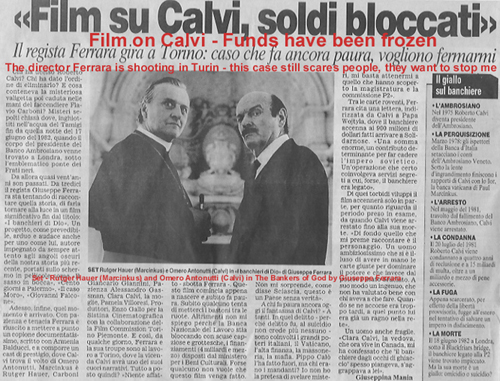
Masonic Lodge Propaganda Due (P2).
Formed in the 19th century by the Grande Orient of Italy for the elites, the organization evolved out of the violent organization known as the Carbonari. Pagan elements suffused the rituals of the organization to which all Grand Masters of regular Italian Freemasonry of course belonged. The head was known as Naj Hannah (King Cobra).
In interviews two former members have described the oaths they took. They were taken to a compound, a Villa hidden in the Apennines in the region of Tuscany. A 12-foot wall seals the neatly manicured grounds from view. In the centre of the main courtyard stands a fountain shaped like a tree trunk. The cobralike sculpture, with its inflated hood, watches over the compound in a protective posture, as if ready to strike. The cobra's head is twice the size of a human skull. It has a single eye, which is blue during daylight and red after nightfall, for inside the cobra's hood and behind its eye there is a closed-circuit camera that follows a visitor, invited or unwelcome, as the fountain rotates in the direction the intruder moves. The fountain- camera is controlled from a room within the villa where eight monitors, each with five stations, cover eight guest rooms, patio, pool, dining room, sitting room, and party room. Approximately ten cameras, including the one inside the cobra, have infrared lenses. All of the exterior cameras are camouflaged by the landscaping. The Villa's interior is magnificent. Every room has marble floors and is furnished with antiques. Observing the high ceilings, the finely crafted gold-leaf moldings, the portraits of Mussolini, Hitler, and Peron, the visitor experiences a feeling, a sort of living, breathing odor of danger and power that penetrates the soul and cell by cell contaminates the mind with fear. The year is 1964.
In the meeting room, twelve members of P-2, dressed in satin ceremonial robes and wearing black hoods reminiscent of those worn by members of the Ku Klux Klan, sit in leather chairs at a red marble conference table. They are the elite members of the Wolf Pack, Gelli's disciples - some say his execution squad. None of the black-clad disciples knows the identity of any of his eleven brothers. Grand Master Licio Gelli is the only one who bares his face. Two Masons stand post at the entrance to the meeting room. Their faces are also covered. They are Naja Hannah's personal bodyguards some say his death squad-former Mussolini Facists whose job is to protect the Grand Master and kill any of the twelve disciples who betray the cause "Il Momento di Passare all"(The Time for Real Action). Like Naja Hannah and his disciples, each bodyguard carries an axe; they also bear automatic weapons.
The ceremony begins. There is an uneven series of knocks at the door. "Your Worshipful," a disciple announces, "a pagan wishes to enter". The Grand Master strikes the table with one blow with his axe. Immediately the oversized door swings open and slams against the inner wall. Two guards escort the initiate to the center of the room where he faces the twelve Masons with his back to the grand masters throne. The Pagan, as he is called, is wearing a plain black hood and a blindfold. His identity is known to Grand Master Licio Gelli but to no one else. He is asked one question by each of the disciples, but the Pagan does not answer, instead, one of the guards speaks for him. Once all the ritual questions about purpose and belief and reason for wanting to become a member of Propaganda Due are answered, the Pagan is turned to face the Grand Master, who asks, "Pagan, are you prepared to die in order to preserve the secrets of Propaganda Due?" The initiate now answers for himself: "I am." "Do you have the necessary quality of contempt for danger?" "I do." "Do you have the necessary quality of courage?" "I am courageous." "Do you proclaim yourself an Anti-Communist?" "I do". "And Pagan, are you prepared to fight and perhaps face shame, even death, so that we who may become your Brothers may destroy this Government and form a Presidency?" "I am". Then the blindfold is removed. It takes a moment for the initiate's vision to clear, because this is the first time since entering the compound that he has been allowed to see light. The blindfold serves a purpose other than security. It also represents the power of P-2: "Without membership one is blind; with the help of the order, however, the way is clear."
St. Peter's Banker
Luigi DiFonzo
Franklin Watts Ltd.
1983
Licio Gelli, Grand Master P2.
Called Naja Hannah (King Cobra) by P2 members. Born 1919 in Pistoia, a provincial capital of Tuscany. At Seventeen he left high school to fight with the Fascist Italian Blackshirt division in Spain, and during World War II Gelli zealously supported the Italian dictator, Benito Mussolini. Gelli served as an Officer in the notorious German SS Herman Goering Division which saw extensive duty in the battles of Sicily and Mainland Italy. When the dictator fell, Gelli fled to Argentina, where he allied himself with Juan Peron, became Peron's economic advisor to Italy, and was granted dual citizenship.
Operated in the "Rat Line" which orchestrated the escape of hundreds of indicted or suspected Nazi War Criminals, "Scientists", and Nazi Intelligence Officers including likely Klaus Barbie the Butcher of Lyon, Via Switzerland to South America under the direction of O.S.S./C.I.A., and M.I.5 using the code name "Operation Paperclip".
With the help of the Grande Oriente of Italy the Anti-Fascist Commission cleared Gelli of War Crime charges related to his involvement with the executions of Partisans by the SS, contradicting claims by Masons of Anti-Masonry by Italian Fascists, and Anti-Fascism by Italian Masons. When Juan Peron died, Eva Peron called him back to organize the transition.
In early 1960's he joined the Masonic Order of Freemasonry known in Italy as the Grande Oriente (recognized by mainstream Freemasonry UGLE & U.S. Grand Lodges). As Grand Master of P2 Gelli declared himself "a lifelong anti-communist".
Member of C.I.A. and M.I.5 "Stay Behind" Underground Resistance Force Plan with the codename Operation "Gladio", who worked under the direct supervision of Freemason Dulles, who later became the C.I.A. director fired by JFK. In the event of a takeover by Communists or anyone else the C.I.A., M.I.5 or Pentagon didn't like in Europe or Latin America, "Gladio" would wage a clandestine war of subversion and terrorism against the offending Government/ Movement/People. This is likely what happened to Salvadore Allende of Chile and the Socialist Government of Greece in the "Colonels Coupe".
Under Gelli P2 Masonic Lodge was the most powerful, political, and violent secret organization in Italy. Important Italian Generals, magistrates, and businessmen became members of P2 Masonic Lodge which Gelli served from the hierarchy of Freemasonry. Determined to destroy Italy's parliamentary system of government in order to form a Presidential Dictatorship, Gelli recruited members who swore allegiance to him rather than to the nation of Italy.
Gelli was not brilliant so much as shrewd and devious. He had money and power, but he realized that wealth and position meant little without the weapon of fear. Gelli believed that fear was the instrument by which real power could be masterfully employed, and he believed fear was most useful when cloaked in silence. So Grand Master Gelli divided members of P2 Masonic Lodge into divisions and forbade them to disclose their membership.
In 1980 Gelli was the Guest of Honour at one of Ronald Reagans Presidential Inauguration Balls. It has been suggested that Gelli worked closely with Reagan C.I.A. Director Appointee William Casey in the "October Suprise" involving the delayed release of U.S. hostages held by the Ayhatola Khomeni until after the elections, which contributed greatly to Jimmy Carters defeat.
Ronald Reagan received an "honorary" 33rd Scottish Rite Freemason Degree after he was elected President.
St. Peter's Banker
Luigi DiFonzo
Franklin Watts Ltd.
1983
Now the Vatican suddenly realized Fremasonry was still a perfect vehicle for conspiracies against Church and State. 'Times change,' the English bishops had said in 1974. They failed to say that Freemasonry remains the same. The P2 scandal was 1738 and 1848 all over again. 'Men of goodwill' in Britain, France and Italy would bluster that P2 had nothing to do with 'regular' Freemasonry, but this was a lie and those who uttered it were either fools or knaves. P2 was a recognized part of the 'regular' Grand Orient of Italy - itself recognized by the Grand Lodge of England in 1972 - and three successive Italian Grand Masters were up to their necks in the conspiracy.
Chapter 33 - 'Spooks in Aprons'
Inside the Brotherhood, by Martin Short
Harper Collins, 1990, 1993, 1997
Curious Ommissions
'St. Peter's Squared', Chapter 8 Excerpts
Inside the Brotherhood, Martin Short
Harper Collins, 1989
If they were not doing evil they would not have so great a hatred of the light.Ever since 1738 when Clement XII issued his bull In Eminenti against the 'depraved and perverted' societies of Freemasons, the Roman Catholic Church has been condemning Freemasonry as if it were the child of the devil. Ironically, it was only in recent years, as Protestant churches were at last plucking up courage to round on the brotherhood, that the Vatican softened its opposition and seemed almost to welcome its centuries-old enemy beneath the canopy of St Peter's itself.
Since we are taught by the divine word to watch, like a faithful servant, night and day, lest this sort of men break as thieves into the house, and like foxes endeavour to root up the vineyard... we do condemn and prohibit the same societies...The Pope commended that no members of 'the faithful in Christ', whatever their status, laymen or clergy, shold join Masonic societies, or give Masons shelter, help them meet, 'afford them counsel, help or favour', assist them to recruit, or 'in any manner aid and promote them'. those who did would suffer the penalty of excommunication 'without any other declaration; from which no one can obtain the benefit of absolution from any other but us... except at the point of death'.
Enforcing the new law fell to the Holy Inquisition which promptly jailed an Italian
member of the Florence lodge. The lodge closed but some of its members still conspired
against Rome. For the enxt 100 years Freemasonry grew throughout Italy as a cover for
nationalist revolutionary activity. According to one Masonic writer, from the middle
of the nineteenth century 'the salient point of Italian politics was war against
Catholicism directly led by the lodges'. By 1848 Piux IX and the Papal States were
overwhelmed by the movement for Italian unification. The papal prime minister was
assassinated, an act which the revolutions leader,[and Mafia founder - FW] the Freemason
Giuseppe Mazzini, deemed 'necessary and just'. Rome rebelled, Pius fled, and Mazzini
set up a Roman Republic. It did not last. In 1850 the French put Pius back on the Roman
throne, but the secret societies had signalled th eend of his territorial power. Twenty
years later Italian unity was achieved, largely through the efforts of three Masons;
the revolutionary Mazzini, the soldier Garibaldi and the statesman Cavour. By 1870 these
men had destroyed the Pope's earthly dominion. Rome was made the capital of an
independent secular nation state and the Papacy was reduced to 109 acres around St. Peter's.
In his tortured thirty-two year reign Pius IX issued six bulls attacking Masonry but the
definitive condemnation came in 1884 with Humanum Genus , in which Leo XIII lamented
that the pontiff was falsely
deprived of temporal power, the stronghold of his rights and of his freedom; he was
next reducted to an iniquitous condition, unbearable for its numberless burdens until
it has come to this, that the sectarians may openly say what they had already in secret devised
for a long time, namely, that the very spiritual power of the Pope ought to be taken
away and the divine instituition of the Roman Pontificate ought to disappear from the world.
Leo endorsed the view that the Freemasons' 'real supreme aim' is 'to persecute Christianity
with untamed hatred, and they will never rest until they see cast to the ground all
religious institutions established by the Pope'. Masons insinuate themseles 'into the
hearts of Princes' in order to exploit them as 'accomplices to overcome Christianity'. Then
they resole to 'shake the foundations of the thrones, and persecute, calumniate or banish those
sovereigns who refuse to rule as they desire'. The Masons deceived the people too into
believing that 'the Church is the cause of the iniquitous servitude and misery in which
they are suffering' but, 'It would be more according to civil wisdom and more necessary
to universal welfare that Princes and Peoples, instead of joining the Freemasons against
the Church, should unite with the Church to resist the Freemasons' attacks'.
The turning point was the Papacy of John XXIII. In 1962 his second Vatican Council promoted a new climate of religious tolerance and raised hopes of a coming together of all churchs and faiths. It called for a dialogue with all 'men of goodwill' who showed a readiness to talk with the Church. Leading Masons felt this must include them because their order was built on a similar concept of 'gather together, beyond the limits of the various religions and world views, men of goodwill on the basis of humanistic values comprehensible and acceptable to everyone. It was also told that Masonry's moral values encourage men to embrace their own religions even more strongly, so that Catholics who are Masons become even better Catholics.
In the decade after Vatican II, Catholic leaders in several countries were solicited by Freemasons. In 1968 a prominent English Mason named Harry Carr persuaded the Cardinal Archbishop of Westminster to propose a softer line on Freemasonry to the Vatican. Cardinal Heenan was sympathetic because of the sad tale of one of his parishioners. In his autorbiography he told of his visits to a Yeoman of the Guard (a Beefeater at the Tower of London) who was 'over seventy with a well-trimmed white beard'. The man always attended Sunday Mass and 'prayed with great recollection', but never took Communion. 'There was only one black mark in the Yeoman's record. He had not received the sacraments within living memory. His children knew the reason. In the army he had become a Freemason in the belief that this would further his career.'
Heenan felt it was 'probably only a matter of time' before the general ban on Masonry would be lifted, but not even he dared ask the Vatican to allow the Yeoman to take Communion while he was still a Mason. Instead the Cardinal urged the Beefeater to quit the Craft, but he never did because he 'was under the almost certainly false impression that he would have to cease to be a Yeoman if he resigned from his masonic lodge'.
As it happens, the Yeoman's 'impression' was almost certainly correct for the Craft is strong in the army, the Territorials and in many quasi-military organizations. At that time it may have held sway among Beefeaters. Ignoring such worldly obstacles, Heenan embraced Carr's view that 'regular' Masons had never plotted against the Church and accepted the need to draw a 'sharp line' between English-style Freemasonry and the 'athiestic or anti-Christian Grand Orient type'. In his own book Carr says he urged Heenan to urge Rome that it could use the English model to disinguish between good and bad Freemasonry. He added: 'What we really need is an intermediary, to convince your authorities.' Heenan replied: 'I am your intermediary.'
The Cardinal then took up the cause of 'regular' Freemasonry with Pope Paul VI. By 1971 he was able to report some progress...
Similar Church-Mason canoodling was going on in France, where Freemasonry has an even stronger anti-clerical tradition than in Italy. The French Revolution was largely inspired by Masonic notions and by masons such as Diderot, Voltaire and Lafayette. French history thereafer is littered with Masonic onslaughts on Catholics and Catholicism...
In March 1985 the Vatican newspaper, L' Osservatore Romano, published an article showing that all those cosy chats between folk like Harry Carr and Cardinal Heenan had missed the central issue. What mattered was not which lot of Masons plotted against the Church but whether Freemasonry's 'philosophical ideas and moral conceptions' could ever be reconciled with the fundamentals of Christian faith. Even a century before, when the Papacy had just been territorially destroyed by Masons, its oposition had been primarily doctrinal. In Humanum Genus Leo XIII condemned the brotherhood's 'rationistic naturalism'. Elsewhere, he said: 'Christianity and Freemasonry are essentially irreconcilable, so that enrolment in one means separation from the other.' L' Osservatore Romano expressed in its Latin way most of the objections later raised by Britain's Protestant Churches.
Above all it must be remembered that the community of 'Freemasons' and its moral obligations are presented as a progressive system of symbols of an extremely binding nature. The rigid rule of secrecy which prevails there further strengthens the weight of the interaction of signs and ideas. For the members, this climate of secrecy entails above all the risk of becoming an instrument of strategies unknown to them.Freemasonry's 'relativism', its failure to differentiate between right and wrong paths to God, reducing all religions to facets of 'a broader and elusive truth', is unacceptable. A Catholic cannot
live his relation with God in a two-fold mode... dividing it into a supraconfessional humanitarian form and an interior Christian form. He cannot cultivate relations of two types of God, no express his relation with the Creator through symbolic forms of two types... On the one hand, a Catholic Christian cannot at the same time share in the full communion of Christian brotherhood and, on the other, look upon his Christian brother, from the Masonic perspective, as an 'outsider'.After fifteen years of flirting with Freemasonry, the Church had come back to where it had stood before Vatican II, and before that for more than 200 years. Yet from 1974 an unknown number of Catholics had joined the Craft. The Vatican has still not made clear where they now stand. Should they follow a 1911 decree which instructed Catholic Masons to move into 'passive membership' abstaining from all participation and 'communion' with Fremasonry, or quit altogether if they can so do without causing themselves or their family 'serious harm'? Without express guidance, Catholics already active in Freemasonry will probably stay active. They may find 'grave sin' more fun than Holy Communion.
The dalliance is over, but crucial questions still need to be answered. Why did the kissing stop in 1981? And how had it ever begun? Was it just Vatican II which caused the Church to drop its centuries-old hostility or was some other force at work?
A 'topside' interpretation might claim the kissing had to stop as soon as Germany's bishops produced a devastating statement on six years of discussion with their Masonic countrymen. In 1980 they reported: 'It is impossible to belong to the Catholic Church and to Freemasonry at the same time.' For all the Craft's humanitarian and charitable aspects, and its stand against 'materialistic ideology', it still denies the 'objective validy of revealed truth'. Being a Mason 'is to question the fundamental principles of Christian life'. The bishops slated Freemasonry for its many 'isms': indifferentism, relativism, subjectivism, deism. To the Msons 'all religions are competitive attempts to express the ultimate unattainable truth about God'. This 'undermines the faith of a Catholic' whose Church - despite Vatican II - still lays claim to absolute truth.
The bishops' statement was published ten months before the Vatican made its 1981 declaration that Catholic Masons still faced excommunication, but everything they said was as plain as a Swiss Guard's pikestaff. Anyone with the slightest awareness of Catholic dogma and Masonic 'tolerance' would already have known the two could never be reconciled without intellectual dishonesty. It is unlikely, therefore, that the volte-face had nothing to do with the German bishops but everything to do with the scandal of Propaganda Massonica Due, the 'regular' Masonic Lodge otherwise known as P2.
I tell the inside Masonic story of P2 in Chapter 33. Here I point out that this plot to subvert the entire Italian nation first penetrated St Peter's in the 1960s, soon after Vatican II. It was only on the eve of the P2 scandal that the Sacred Congregation published ints 1981 'no-change' statement. P2's shocking 'state within a state' membership lists were discovered one month later, but magistrates had already been investigating P2's Grand Master Lucio Gelli for two years and knew how deeply he and his Masonic cronies had subverted the Vatican in the eighteen years since Paul VI had become Pope.
Now the Vatican suddenly realized Fremasonry was still a perfect vehicle for conspiracies
against Church and State. 'Times change,' the English bishops had said in 1974. They
failed to say that Freemasonry remains the same. The P2 scandal was 1738 and 1848 all over again.
'Men of goodwill' in Britain, France and Italy would bluster that P2 had nothing to
do with 'regular' Freemasonry, but this was a lie and those who uttered it were
either fools or knaves. P2 was a recognized part of the 'regular' Grand Orient of
Italy - itself recognized by the Grand Lodge of England in 1972 - and three
successive Italian Grand Masters were up ot their necks in the conspiracy.
Yes Virginia, Freemasonry Lies
'Spooks in Aprons', Chapter 33 Excerpts
Inside the Brotherhood, Martin Short
Harper Collins, 1989
Despite the combined claims of Bentine, Knight and Chinaman, I sense that this 'KGB infiltration' view of British Freemasonry is a distraction: not invalid, but far less significant than the greater truth that stolid Whitehall bureaucrats have joined Freemasonry in far greater numbers than any spies. Such mandarins may be mediocure, even incompetent, but they are the people who keep the ship of state afloat. If a few of them corruptly feather their nests by feeding juicy contracts to Masonic friends in private industry, so be it. These men may not be the backbone of the civil service, but they constitute several ribs.
Knight went more dangerously off-course with a second KGB theory: that Italy's P2 Masonic Lodge conspiracy was a KGB plot. He was fed this idea by someone whom he described as 'an impeccable source within British Intelligence', but his strongest evidence appears to have beeen the perverse fact that of all Italy's leading political parties, 'only the Communist Party had no links with P2' and so could exploit the P2 scandal with impunity. 'From the beginning,' he continued, 'Lodge P2 was a KGB-sponsored programme aimed at destabilizing Italy, weakening NATO's southern flank, sweeping the Communists into power in Italy, and sending resultant shock waves throughout the western world.'
Even when The Brotherhood first appeared, this seemed an unlikely story. Five years later it is clear that Knight's 'impeccable source' had filled him with disinformation. To understand this government spook's motives we have to explore the P2 story from several angles, but first a brief summary of P2.
In March 1981 two Milan magistrates were investigating the fake kidnapping in 1979 of a swindling Sicilian-born international banker, Michele Sindona. They were also probing his role as financial advisor to the Vatican and the Mafia. They discovered that, while he was hiding in Palermo, one of his 'minders' had travelled 600 miles north to Arezzo to visit a textile manufacturer, Licio Gelli. They promptly ordered a search of Gelli's premises. On 17 March finance policemen discovered 962 Italian names on lists kept in his office safe and a suitcase. The names belonged to members of a Masonic Lodge named Propaganda Massonica, also known as P2. Gelli was its Venerable Master.
What astonished the investigators was that the names on the lists amounted to a state within a state. They included forty-three MPs (among them three cabinet ministers), forty-three generals and eight admirals (including the current heads of all the armed forces), security service bosses, hundreds of public servants and diplomats, the police chiefs of Italy's four biggest cities, industrialists and financiers, television stars and twenty-four journalists, including the editor and publisher of Corriere della Sera. Sindona was a member. So was another controversial banker, Roberto Calvi, who would later be found hanging under London's Blackfriars Bridge.
But who was Gelli? In succeeding months the magistrates discovered that this seeming small-town industrialist was a fascist war criminal who had opportunistically betrayed his colleagues as soon as he realized Germany was going to lose the war. A few years later his past caught up with him, so he fled to Argentina and made valuable political friends such as General Peron. In the mid-1960s he returned to Italy and was appointed Argentina's honorary consul. He soon had connections everywhere. He had no problems doing textile business in Eastern Europe, but he also popped up in Rome's right-wing circles. He even had friends in america's Republican Party, through whom he was invited to President Reagan's 1981 inauguration. He was masterly at collecting influential people. He manipulated them to aggrandize himself. At times his motive seemed to be finanacial, at others ideological, but what was his ideology? What mystified the Milan magistrates - and other people on his trail - was, who did he really work for? For Italy's secret services, for America's CIA or Russia's KGB?
The KGB theory was always the least likely. There was little evidence to support it, whereas there was overwhelming proof of Gelli's continuaous involvement with fascism for more than forty years. Significantly, the 'P2-KGB plot' fantasy resembles a parallel propaganda myth which fooled many other journalists at the time: that the 1981 assassination attempt on Pope John Paul II was a Bulgarian plot. 'Western inteligence experts are now generally agreed that the attempted killing was inspired by the KGB," wrote Stephen Knight. If Western Intelligence experts really believed that, the West was (and is) in deep trouble.
It has now been shown that this theory was concocted by two Americans: a former CIA operative named Paul Henze and a right-wing journalist named Michael Ledeen. Ledeen had previously known a rising Italian businesman, Francesco Pazienza, who had links with SISMI: Italian Military Intelligence. However, Pazienza rejects the 'Bulgarian plot' theory and claims he is himself the victim of black propaganda, falsely branded as a P2 member and as Gelli's nominated successor. He is a Mason, but says he never met Gelli. In 1988 he was sentenced to a ten years in prison over the 1980 bombing of Bologna railway station, but he claims he will be cleared on appeal.
At a future date I hope to portray the political, military, and commercial rackets which P2 members have continued to perpetrate years after P2 was officially dissolved. Here I show how the reactionary forces, in Italy and America, which created P2 are tied in with British Intelligence and British Freemasonry. Many of my comments are based on evidence gathered by an Italian Parliamentary Inquiry into P2. Its 1984 report was never published in English. Indeed, it has rarely been mentioned in the British or American media, even though its contents have world wide significance. The report also helps explain why - and on what basis - British Intelligence misled Stephen Knight into believing P2 was a KGB plot. To understand P2, however, we must have some idea of the history of Freemasonry in Italy.
The brotherhood has had a controversial history ever since it reached Italy in the early 1730's(see Chapter 8), but its politcal ascendancy was ended in 1925 when it was outlawed by the fascist dictator Benitio Mussolini. Twenty years later it was legalized again, but only after the US Office of Strategic Services (the forerunner of the CIA) had pressured Italy's weak and impoverished government. The OSS planned to use Freemasonry just as it used the Mafia: to prop up a sickly democracy threatened by Soviet-inspired destablization and the prospect of a communist election victory.
The OSS/CIA backed Italy's strongest Masonic faction, the Grand Orient, which today has some 15,000 members. From 1961 until 1970 its Grand Master was Giordano Gambernini who (whether for the CIA or his own ends) sought to influence Italian elections by canvassing for candidates who were Freemasons and giving them money. At the time he was desperate to win recognition from the United Grand Lodge of England, which most 'regular' Masons in the world regard as the sole source of legitmacy. If England could be persuaded to recognize the Grand Orient, all other Grand Lodges would follow suit. England had always refused, largely because of Italian Freemasonry's historic involvement in politics. This offends the Basic Principles on which England's Grand Lodge decides whether to recognize any other. Principal 7 states: 'The discusion of politics and religion within the Lodge shall be strictly prohibited.' By meddling in politics Gambernini was breaching this principal, so the Grand Lodge of England should have shunned him like the plague. Instead it acted as if in totaly favour - or blissful ignorance - of his political game.
In the 1960s Grand Lodge was more distracted by the fact that the Grand Orient (also
known as 'Palazzo Giustiani') was one of two Italian Grand Lodges clamouring for
recognition. There was also the Palazzo del Gesu, with some 5,000 members. James
Stubbs, then England's Grand Secretary, described the dilemma in his 1985 biography,
Fremasonry in my Life:
It was... well known in Italy that we were not prepared to plump for
one, leaving theother out, or even to recognize them both; eventually the moment
came when at elast the cracks were papered over and the Palazzo Giustiniani seemed
to be in control. We felt justified in recognizing Italy.
The man who had master-minded the unification of the Grand Orient and Palazzo
del Gesu, paving the way for recognition by England, was none other than the
subsequently notorious Licio Gelli. He had entered Freemasonry only in 1965, yet
he was instantly recommended to Grand Master Gamberini as someone 'able to make a great
contribution to the institution in terms of recruiting qualified people'; in other
words, to draw into Masonry men dedicated to right-wing goals. If we remember the OSS's
fierce anti-communist intent in resurrecting Freemasonry after World War II, and
Gamerini's 1960s electioneering, it is clear that the political meddling of modern
Italian Freemasonry did not start with Licio Gelli. He merely increased its effectiveness.
In 1970 a Florence doctor named Lino Salvini became Grand Master. This freed Gamerini to act as the Grand Orient's roving ambassador in the search for international recognition. At the same time he sought to develop Propaganda Massonica Lodge (P2) as a nexus for the Italian Right to seize control of Italian society, if ever the need arose. The lodge had been founded in 1877 to meet the needs of provincial Masons living temporarily in Rome and thus unable to attend their home lodges. It soon evolved into a 'reserved' or secret lodge whose members were known only to the Grand Secretary, allegedly to protect them from Papal wrath.
In the mid-1960s P2 had only fourteen members, but in 1970 Salvini asked Gelli to 'restructure' the lodge. Suddenly numbers soared. Within a decade it had 400 members, a few years later almost 1,000. Gelli has received all the credit and blame for this achievement, but Gamberini supervised many of the initiation ceremonies which Gelli performed in P2's Excelsior Hotel headquarters. Grand Master Salvini was just as involved. In December 1971 he told P2 members that henceforth they could pursue their 'profane' (worldly) aims under the cover of their concealed order:
If until known it has not been possible to meet at our places of work, with this restructuring we shall have the possiblity and pleasure of more frequent meetings, to discuss not only the various problems of a social and economic order which interest our brothers, but also those regarding the whole of society.The minutes of one P2 meeting in the early 1970s reveal what kind of society appealed to Gelli, Salvini and Gamberini. Gelli wrote that members discussed:
the political and economic situation of Italy, the threat of the Italian Communist Party, in accord with clericalism, aiming at the conquest of power, the lack of power in the forces of law and order, the spread of immorality, indiscipline and all the worst aspects of morality and civic virtue... relationships with the Italian state.In a note to absent members Gelli added:
Many have asked... how we should behave if one morning we awoke to find the clerico-Communists had seized power, whether it would be best to resign ourselves to passive aquiescence, or to take on well-defined positions - and if so, on the basis of what emergency plan.In other words, P2 was a secret cell for the preparation of a right-wing coup like those which engulfed Greece in 1967 and Chile in 1973 (in Chile's case, to overthrow President Allende, who was a communist Freemason of an 'irregular' Masonic order). Gelli hosted frequent P2 meetings where the politics of destabilization and subversion were discussed by police chiefs, army generals, security service bosses and appeal court judges. He knew this was not orthodox Freemasonry: 'Philosophy has been banished, but we felt we had to do this in order to tackle only solid and concrete arguements affecting national life.'
During these years Grand Master Salvini knew exactly what Gelli was doing, indeed he had told him to do it. The same year that P2 'banished philosophy' with Salvini's blessing, Salvini himself was blessed by the Grand Lodge of England. In September 1972 Great Queen Street declared it was 'convinced that the time is ripe and conditions are favourable' for recognizing the Grand Orient.
The 1970s were some of the blackest years in the history of modern Italy. The state was torn apart by left- and right- wing terror, but many of the horrific acts originally blamed on the Left (from the Red Brigades to the Communist Party) turned out to be acts of black propaganda by the extreme Right. These included the 'Italicus' train bombing in 1974, in which twelve people were killed, and the 1980 Bologna Station massacre in which eight-five died. In both events P2 had a guiding control.
In July 1976 the Grand Orient formally suspended P2, but Salvini secretly authorized it to carry on. At a meeting in Rome in September a 'democratic' Mason named Francesco Siniscalchi asked Salvini to answer a series of questions on Gelli and P2. Siniscalchi added that if a 'profane' (non-Masonic) magistrate ever asked him what he knew about Masonic wrongdoing he would have to tell the truth. Salvini not only refused to answer the questions; he expelled Siniscalchi and other 'democratic' Masons from the Grand Orient as traitors for daring to confront him.
In December 1976 he (Siniscalchi) gave Rome judges a dossier exposing numerous illegalities by Gelli and his P2 clan. It was this dossier, and other discoveries by Siniscalchi, which first exposed the P2 conspiracy to 'profane' eyes. Five years later, when finance police raided Gelli's office, they alrady had a good idea from Siniscalchi what they might find.
In 1987 I wrote to Grand Secretary Ernesto Zampieri and asked why the Grand Orient had not reinstated its expelled brother Siniscalchi and honoured him for the sterling service which he had done Italian Freemasonry exposing the evil of P2. Zampieri's reply made no reference to Siniscalchi but stated: 'We can assure you that our organs of Justice do act with a great sense of responsiblity from the safeguard of our institution.' This presumably means Siniscalchi will not be reinstated, probably because the Grand Orient feels he has done it no good whatsoever. Like many Masons who practise the movement's finest principals, Siniscalchi has been ostracized by his Masonic bosses who, no doubt, would have preferred him to keep his mouth shut.
In September 1981 the Grand Lodge of England felt obliged to explain where it stood to its own bemused members, 'in view of the very wide publicity attracted by the so-called P2 Lodge'. It said it had recognized the Grand Orient in 1972 when satisfied that it accepted Principle no. 7 banning discussion of politics and religion. Now, Grand Lodge said, it 'had been informed' that the Grand Orient had suspended P2 in 1976 and had authorized no Masonic activity by P2 since then. Licio Gelli had also been suspended, and the Grand Orient had recently reaffirmed adherence to the Principles of Recognition, including no. 7. Grand Lodge would keep the matter under review, but in the meantime did not intend to take action.
Had Grand Lodge 'been informed' of the real truth if would have had to take action, even to withdraw recognition, but its 1981 statement contained many untruths. P2 was not a 'so-called' lodge. It had been a legitimate lodge for almost a century. Furthermore, its suspension in 1976 had been a sham for as we have seen, Grand Master Salvini promptly authorized it to carry on. In 1977 he instructed Gelli to continue 'perfecting the Masonic vocation of P2 members:
You will answer only to me for what you do to this end, promoting and encouraging those activities which you think of use and interest to Masonry. I am sure that you will conduct the task with the fearless spirit you showed when faced by the treacherous attacks of the traitors of the institution.
Grand Master Salvini resigned in 1978, but his successor, General Ennio Gattelli, continued to accept all Gelli's recruits as legitimate Freemasons. In 1980 the Grand Orient was still accepting lump sum payments from Licio Gelli as P2 members' dues. Battelli also supplied Gelli with blank Grand Orient membershiip cards. In autumn 1981, when P2 had at last been officially dissolved and Gelli suspended, the Grand Orient transferred P2's members to other lodges: an act which proved the P2 shut-down was a cosmetic device. In reality the lodges reactionary ethos was now spread like a virus throughout the Grand Orient.
Salvini had been forced to resign because of intense American Masonic dissatisfation over his relationship with Gelli. Yet the new Grand Master, General Ennio Battelli, brought even greater shame on the movement. It turned out that Gelli had paid for Battelli's Masonic election campaign and then gave him regular pay-offs in succeeding years. The general would later be charged with crimnial involvement with the Bologna Station massacre.
When England's Grand Lodge goes silent about a Masonic controversy the nearest thing to a leak may be found in the magazine Masonic Square. In March 1987 it published an article on Italian Freemasonry which referred to the 'bogus P2 lodge, a spurious body not affiliated in any way to the Grand Orient.' Was this untruth published through ignorance or had the writer been fed disinformation to delude England's Masonic faithful? Either way the writer also claimed that the Grand Orient 'enjoys the warmest relations' with the Grand Lodges of England, Ireland and Scotland.
Perhaps these 'warmest relations' have blinded England's Grand Lodge to the need to
discover and disseminate the truth about Italian Freemasonry. To spread the myth
that P2 was a perversion, rather than the logical climax, of the Grand Orient
tradition would obviously suit the Grand Orient. In the early 1980's not only
England's Masonic masses but also much of the Western press were hoodwinnked into
thinking P2 was not part of Freemasonry at all. This was necessary if a second
act of deception - blaming the P2 scandal on the KGB - could be achieved without
tainting the Grand Orient or the Grand Lodge of England. This may explain why
British Intelligence sought to mislead Stephen Knight in 1983.
Martin Short wrote, produced and narrated the prize-winning ITV documentary
series on the Mafia in America, Crime Incorporated. To accompany the series, he
wrote Crime Inc.: A History of Organized Crime in America. In addition to writing
feature articles for The Times, The Spectator, New Statesman, Time Out and
Special Forces, he co-authored (in 1977) The Fall of Scotland Yard, about police
corruption in London. He is also the author of Lundy: The Destruction of Scotland Yard's
Finest Detective (1991).
 After reading history at Cambridge University, he worked - from 1969 to 1984 - on major
current affairs programmes for the ITV companies Thames, Granada and London Weekend (on
the Lebanon) and for Channel 4's Dispatches series (on the international arms
trade). In 1988 he presented Charlie Richardson and the British Mafia for Longshot
Productions and Channel 4. His series based on Inside the Brothehood appeared on
ITV in 1989, and in 1994 he produced and presented the ITV series Gangbusters.
After reading history at Cambridge University, he worked - from 1969 to 1984 - on major
current affairs programmes for the ITV companies Thames, Granada and London Weekend (on
the Lebanon) and for Channel 4's Dispatches series (on the international arms
trade). In 1988 he presented Charlie Richardson and the British Mafia for Longshot
Productions and Channel 4. His series based on Inside the Brothehood appeared on
ITV in 1989, and in 1994 he produced and presented the ITV series Gangbusters.
Michele Sindona.
Pope Paul VI's banker and confident. This was part of an elaborate scheme by the Mafia, the CIA, MI-5, Neo Fascist Groups, and the defacto controlling body of all Italian Freemasonry - P2 (which was called by Italy's Interior Minister a State within a State) to subvert, bankrupt, and destroy the Vatican and the Parlimentary System and replace it with a "Presidential" system (i.e. a Dictatorship).
Born in 1920 in Patti, Sicily. Sindona became the most successful tax lawyer and the most powerful banker in Italy. Years later, as one of the wealthiest men in the world, Sindona was identified by the Italian and U.S. governments as the Mafia's banker (appointed as such at a International Mafia conclave in Palermo Sicily in 1957). He was accused of washing heroin profits through his banks and of smuggling currency out of Italy through the Bank of the Vatican and help organize with P2 Grand Master Gelli and the CIA/MI5 the coup in Greece in '69, an attempted coup in Italy plus others in Spain and Latin America).
In 1972 Sindona purchased controlling interest of Franklin National Bank. Two years later Franklin Bank collapsed, the largest bank failure in American history. On August 2, 1979, while under indictment, Michele Sindona disappeared and was believed to have been kidnapped by left-wing terrorists(subsequently proved to be a staged kidnapping by Sindona and the Mafia to avoid trial). He reappeared on October 16, 1979, was later convicted of bank fraud, and was sentenced to twenty five years in prison. P2 Masonic Lodge Member.
St. Peter's Banker
Luigi DiFonzo
Franklin Watts Ltd.
1983
Roberto Calvi, Banco Ambrosiano President.
Member Masonic Lodge P2. Received millions of dollars from CIA and British Intelligence which he laundered to P2 for support of various right wing activities and coups throughout Southern Europe and Latin America. Calvi's secretary "falls" to her death from 4th floor window of Banks International Headquarters and then the next day Calvi is found hanging from Black Friars bridge in London with a false passport and twelve pounds of bricks and rocks shoved in his pockets(i.e. masonry).
St. Peter's Banker
Luigi DiFonzo
Franklin Watts Ltd.
1983
Flavio Carboni and Roberto Calvi's Flight
Flavio Carboni is perhaps the key figure in the final stages of Calvi's life. From January 1982 onwards,he would with with increasing frequency visit Calvi in Milan, or for weekend consultations at Drezzo. The small Sardinian, who once boasted to his family he would become the richest man in Italy, would be companion and paid consellor to the chairman of Ambrosiano, right up to the end. Vaunting contacts among the Roman politicians, the press and the highest echelons of Italian Freemasonry, Carboni took over the role that Gelli had once assumed for Calvi - and more besides.
For Carboni was not only on good terms with Armando Corona, who in March 1982 was to become the head of the Italian Grand Orient. He could also enlist the services of such as Ernesto Diotallevi and Danilo Abbruciati, notorious bosses of the Rome underworld. Magistrates would later charge that Carboni's building and property businesses were used to recycle the proceeds of organized crime and maybe right-wing terrorism also. In most of the subsequent discoveries which seemed to link Calvi's Ambrosiano with common crime, the name of Carboni would be a constant thread.
Calvi ws attracted to Carboni, as he was to Pazienza, by his promised access to hidden and therefore real power. Precisely to what extent his helpers were in collusion it is hard to establish. But Calvi feared Carboni, just as he was afraid of Pazienza with his vaguely threatening braggadoccio, and well-advertised secret service connections. Reading of The Godfather was not only instructive of the advantages of hidden power, but also of the fate which might befall those who offended it.
Calvi was by this stage scared not only for his own safety (his retinues of bullet-proof Alfa Romeos and bodyguards were costing his bank four milliion lire every day) but for that of his family as well. From February on, he was imploring his wife to leave Italy for somewhere less dangerous. In May, and with some reluctance, she finally yielded to his urgings and went to join their son Carlo in Washington. And with good reason, for the violent undertows gripping Ambrosiano's affairs had broken dramatically to the surface.
The Life & Death of Roberto Calvi
Rupert Cornwell, Rome Correspondant, The Financial Post
Victor Golancz Ltd, 1983
Roberto Rosone
Despite his lofty rank of genral manager and deputy chairman of Banco Ambrosiano, had lived for many years in a modest first-floor flat in a corner block of Via Olofredi, close to the central station in Milan. On the ground floor of the same building was the branch office No. 18 of Ambrosiano in Milan. It was protected round the clock by armed private guards, as indeed are bank premises up and down Italy, as a matter of routine.
On the morning of April 27, 1982 Rosone left as usual for his office shortly after 8 a.m. Suddenly, as he turned into the street, a man with a pistol stepped forward and fired wounding him in the legs. But the guards had quickly noticed the danger and shot back, killing the assailant outright. To their great surprise police identified the corpse as that of no ordinary Milanese delinquent, bu the important Rome gangland figure Abbruciati.
Abbrucati's links with Carboni, and indeed Carboni's intimate dealings with Calvi, were not yet public knowledge. Even so, the episode raised more questions than it answered, casting a yet more sinister shadow over Ambrosiano. What was a high-ranking gangster from Rome doing carrying out a task that would normally fall to a minion ? Was the attack a botched attempt at murder, to punish Rosone for some affront to the underworld; or was it a deliberate warning and no more, delivered in classic fashion? Or was the warning intended not for him but for Calvi himself? Later, after Calvi and Ambrosiano had perished, as still darker possiblility emerged - that Calvi himself, through Carboni and Abbruciati, was directly or indirectly responsible for the attack on his own vice-chairman, suspected of plotting against him.
What is certain is that Carboni was already receiving money from Calvi. In Italy, Ambrosiano lent large sums to companies owned by Carboni, and Calvi even provided finance to help the camaign of Corona to become the new head of Italian Freemasonry.
The Life & Death of Roberto Calvi
Rupert Cornwell, Rome Correspondant, The Financial Post
Victor Golancz Ltd, 1983
Timeline
Early September 1978: Pope John Paul I asks his secretary of state, Cardinal Jean Villot, to initiate an investigation into Vatican bank operations.
September 28, 1978: John Paul I presents Cardinal Villot with a list of people who are to be transferred, asked for their resignations, or reassigned. All the people on the list are suspected to be members of the Freemason's group "P2." The reshuffle of power will have major implications for the existing Vatican power structure and its financial dealings.
September 29, 1978: John Paul I found dead in his bed. Villot issues false statements to the press about the circumstances surrounding the death, removes key evidence from John Paul's room, and orders the body to be embalmed immediately without an autopsy.
October 1978: John Paul II to replace John Paul I. None of John Paul I's instructions to Villot before his death are carried out.
January 21, 1979: Murder of Judge Emilio Alessandrini, the Milan magistrate investigating the activities of Banco Ambrosiano, whose director, Roberto Calvi, has close ties with Michele Sindona and the Vatican.
March 20, 1979: Murder of Mino Pecorelli, an investigative journalist in the process of publishing articles exposing the membership and dealings of "P2" -- a powerful group of Freemasons whose membership was involved in Vatican financial dealings, and whose founder, Lucio Gelli, was deeply connected with Roberto Calvi.
March 25, 1979: Arrests on false charges of Mario Sarcinelli and Paolo Baffi of the Bank of Italy. The two men were pressing for action on the investigation of the financial dealings of Roberto Calvi and Banco Ambrosiano.
July 11, 1979: Murder of Giorgio Ambrosioli following his testimony concerning Michele Sindona's financial dealings with Calvi and other Vatican interests, the activities of P2 and its members among powerful government and business circles, and the connections between Calvi, Sindona, and Bishop Paul Marcinkus of the Vatican Bank.
July 13, 1979: Murder of Lt. Col. Antonio Varisco, head of the Rome security service, who was investigating the activities and membership of P2 and had spoken with Giorgio Ambrosioli two days before Ambrosioli's death.
July 21, 1979: Murder of Boris Guilano, the Palermo police deputy superintendent and head of Palermo CID. Guilano had spoken with Giorgio Ambrosioli two days before Ambrosioli's death concerning Sindona's laundering of Mafia money through the Vatican Bank into Switzerland.
October 1979: Bomb explosion at the apartment of Enrico Cuccia, managing director of Mediobanca and witness to Sindona's threat to the life of Giorgio Ambrosioli.
February 2, 1980: The Vatican withdraws at the last moment its agreement that Cardinals Guiseppe Caprio and Sergio Guerri and Bishop Paul Marcinkus will provide videotaped depositions on behalf of Michele Sindona in his trial in the US on charges of fraud, conspiracy and misappropriation of funds in connection with the collapse of Franklin National Bank.
May 13, 1980: Michele Sindona attempts suicide in jail.
June 13, 1980: Michele Sindona sentenced to 25 years.
July 8, 1980: Roberto Calvi attempts suicide while in jail on charges of fraud, etc. Later released on bail and reconfirmed as chairman of Banco Ambrosiano.
September 1, 1981: The Vatican Bank, apparently at the request of Roberto Calvi, issues "letters of comfort" acknowledging its controlling interest in, and assuming responsibility for, a more than 1 billion dollar debt of a number of banks controlled by Calvi.
January 12, 1981: A group of shareholders in Banco Ambrosiano send a letter to John Paul II outlining the connections between the Vatican Bank, Roberto Calvi and the P2 and the Mafia. The letter is never acknowledged.
April 27, 1982: Attempted murder of Roberto Rosone, general manager and deputy chairman of Banco Ambrosiano, who was trying to "clean up" the bank's operation.
June 17, 1982: Roberto Calvi found hanged to death from a bridge in London. A few days later, a 1.3 billion dollar "hole" is discovered in Banco Ambrosiano, Milan.
October 2, 1982: Guiseppe Dellacha, executive at Banco Ambrosiano, dead of a fall from a window of Banco Ambrosiano, in Milan.
March 23, 1986: Michele Sindona found dead of poisoning in the Italian jail to which he had been extradited on charges of ordering the murder of Giorgio Ambrosioli.
Albino Luciano, Pope John Paul I
"On September 28, 1978, he had been pope for thirty-three days. In little more than a month he had initiated various courses of action that, had they been completed, would have had a direct and dynamic effect on us all. The majority in this world would have applauded his decisions, a minority would have been appalled. The man who had quickly been labeled "the smiling pope" intended to remove the smiles from a number of faces on the following day.""The Vatican secretary of state, Cardinal Jean Villot... studied the list of appointments, resignations to be asked for and transfers the pope had handed him. He had advised, argued, and remonstrated, but to no avail. Luciani had been adamant."
"It was by any standards a dramatic reshuffle. It would set the Church in new directions - directions that Villot, and the others on the list who were about to be replaced, considered highly dangerous...."
"There was one common denominator, one fact that linked each of the men about to be replaced. Villot was aware of it. More important, so was the pope. It had been one of the factors that had caused him to act, to strip these men of real power...it was Freemasonry."
"The evidence the pope had acquired indicated that within the Vatican City State there were over one hundred Masons, ranging from cardinals to priests."
"Luciani was further preoccupied with an illegal Masonic lodge that had penetrated far beyond Italy in its search for wealth and power. It called itself P2. The fact that it had penetrated the Vatican walls and formed links with priests, bishops, and even cardinals made P2 anathema to Albino Luciani."
"That evening, September 28, 1978, thirty-three days after his election, Pope John Paul 1, "the smiling pope", was declared dead. No official death certificate has ever been issued. No autopsy ever performed. His body was hastily embalmed. Cause of death: Unknown. And Vatican business continues..."
"The facts are here in meticulous detail, documenting widespread corruption within the Vatican and presenting a compelling case that six powerful men, to protect their vast financial and political operations, decided on a shocking course of action -- Pope John Paul I must die."
David Yallop
In Gods' Name
Bantam Books, 1984
 A List of Masons in the Vatican and Italian Church?
The following is a list of Masons reprinted with some updates from the Bulletin de l'Occident Chrétien Nr.12, July, 1976, (Directeur Pierre Fautrad a Fye - 72490 Bourg Le Roi.) All of the men on this list, if they in fact be Masons, are excommunicated by Canon Law 2338. Each man's name is followed by his position, if known; the date he was initiated into Masonry, his code #; and his code name, if known:
THE FOLLOWING CLERGY WERE EXPOSED AFTER THE ABOVE LIST WAS COMPILED:
 Events Foretold? "I Saw Satans' Smoke Entering the Vatican"


Italy - Italy faces new political crisis over ‘tax spying’ - 28/10/06
Italy/U.K. - Calvi Trial to Expose `Dark' Side of Italian History - 23/11/05
Italy/U.K. - The case of God's Banker: Roberto Calvi the trial begins - 06/10/05
Italy - 'God's Banker' murder trial opens - 06/10/05
Italy - Italy opens trial into death of "God's banker" - 06/10/05
Italy - Key facts on Roberto Calvi murder trial - 06/10/05
Italy - P2 Grand Master Lucio Gelli probed in Roberto Calvi murder - 20/07/05
U.K. - On This Day May 26: 1981 Italian Government Resigns - 26/05/05
U.K. - London Police change Ruling on Roberto Calvi death from Suicide to Murder - 20/05/05
Italy/U.K. - Four face trial over 1982 death of banker - 19/04/05
Italy/U.K. - Four indicted in death of 'God's banker' - 19/04/05
Italy/U.K. - P2 Masonic Conspiracy: Four Charged in Murder of Roberto Calvi - 18/04/05
Italy - God's Banker death mystery deepens as coroner robbed of files in Rome - 04/05/04
Italy/U.K. - Mafia squad probe Calvi bag theft - 04/05/04
U.K./Italy - An end to the mystery of God's Banker? - 31/03/04
Italy - Four go on trial for murder of God's banker - 17/03/04
U.K. - Who killed Calvi? - 07/12/03
Italy - Mafia trial over Calvi - 16/10/03
E.U. - Prodi shrugs off EU scandal over missing millions and Freemason Franchet - 26/09/03
E.U. - O.L.A.F. anti-fraud unit to examine roll of Masons in European Union Government - 02/12/02
E.U. - CIA and Freemasons among dark forces in Europe - 24/09/02
Italy - Has P2 launched a new terror killing spree in Italy? - 01/05/02
Italy: Berlusconi: The power of personality - 14/05/01
U.K. New evidence that Hess died with Duke of Kent in 42' plane crash - 21/04/01
Switzerland: Rothschild Bank AG Zurich tied to Calvi Murder and P2 Masonic Lodge - 07/03/01
U.K.: Professor of Freemasonry to probe murky past of Masonic Brotherhood - 01/07/00
Italy: Operation Gladio, Clockwork Orange, and P2 - 21/05/00
Vatican-Columbia: Priest who fought Freemasons beatified by the Pope - 09/04/00
Germany-Canada: Schreiber: The man who would topple kings - 14/01/00
Italy-U.K.: 'God's Banker' exhumed - 16/12/98
Italy-U.K.: Body of 'God's banker' to be exhumed - 10/11/98
Italy-U.K.: Light to be Thrown on Murky Death of Italian Banker Calvi - 10/11/98
Italy-France.: Gelli deported back to Italy - 16/10/98
France: Gelli extradition approved - 07/10/98
Italy-France: Gelli attempted suicide - 14/09/98
Italy-France: Gold found in Gelli's plantpots - 13/09/98
Italy-France: Fugitive Italian banker arrested - 11/09/98
Italy: Italian Justice Minister Quits in Scandal Over Masonic Lodge - 23/05/81


